The 2026 FIFA World Cup drew to a close on Sunday, 19 July, with Spain lifting football's biggest prize after an unforgettable final against defending champions Argentina.
Across five and a half weeks, three host nations and 104 matches, the tournament delivered everything fans could hope for. Last-minute winners, unexpected exits, breakout stars, and memes and moments that will be remembered for years to come.
Whether you're a lifelong football supporter, someone who tunes in for every major sporting event, or simply caught up in the excitement, the FIFA World Cup has a unique way of bringing people together.
But that energy doesn't always translate into something positive.
Major global events, from sporting tournaments and election seasons to other moments that capture worldwide attention, all share a few things in common. Along with dominating headlines, they also have a tendency to change how people behave on social media.
Compared to the 2022 World Cup, the tournament saw a fifteen-fold increase in online abuse, highlighting how major global events can intensify harmful behaviour across social media.
At Farosian, we've spent more than 11 years analysing online behaviour through our Social and Digital Media Screening solutions. One trend has remained remarkably consistent. Whenever emotions run high, so does the volume of harmful online activity.
Hate speech. Discrimination. Harassment. Personal attacks. Threats.
These aren't isolated incidents. They emerge in clear waves, often coinciding with moments that attract millions of engaged and emotionally invested people.
The statistics released by FIFA following the 2026 World Cup offer one of the clearest examples of this pattern to date.
This growing concern is exactly why FIFA introduced its Social Media Protection Service (SMPS) during the 2022 FIFA World Cup in Qatar.
The service was designed to monitor, identify and manage harmful online content directed at players, teams and officials across multiple social media platforms.
The decision wasn't made in isolation.
Prior to launching the SMPS, FIFA commissioned research analysing more than 400,000 social media posts and comments made during the semi-finals and finals of UEFA EURO 2020 and the CAF Africa Cup of Nations 2021. The findings were alarming. More than half of all players analysed received some form of discriminatory abuse online.
A 2022 OFCOM report revealed that almost 75% of all Premier League Players are subjected to online abuse.
As social media has evolved into one of the world's largest public forums, scrutiny and criticism are no longer confined to newspapers, television or radio. Today, anyone with an internet-connected device can create, share and amplify content capable of reaching thousands, or sometimes even millions, of people.
For elite athletes, that means every missed penalty, controversial decision or disappointing result can trigger an avalanche of abuse within minutes.
The scale of that abuse has grown dramatically.
FIFA's SMPS statistics for the 2026 World Cup
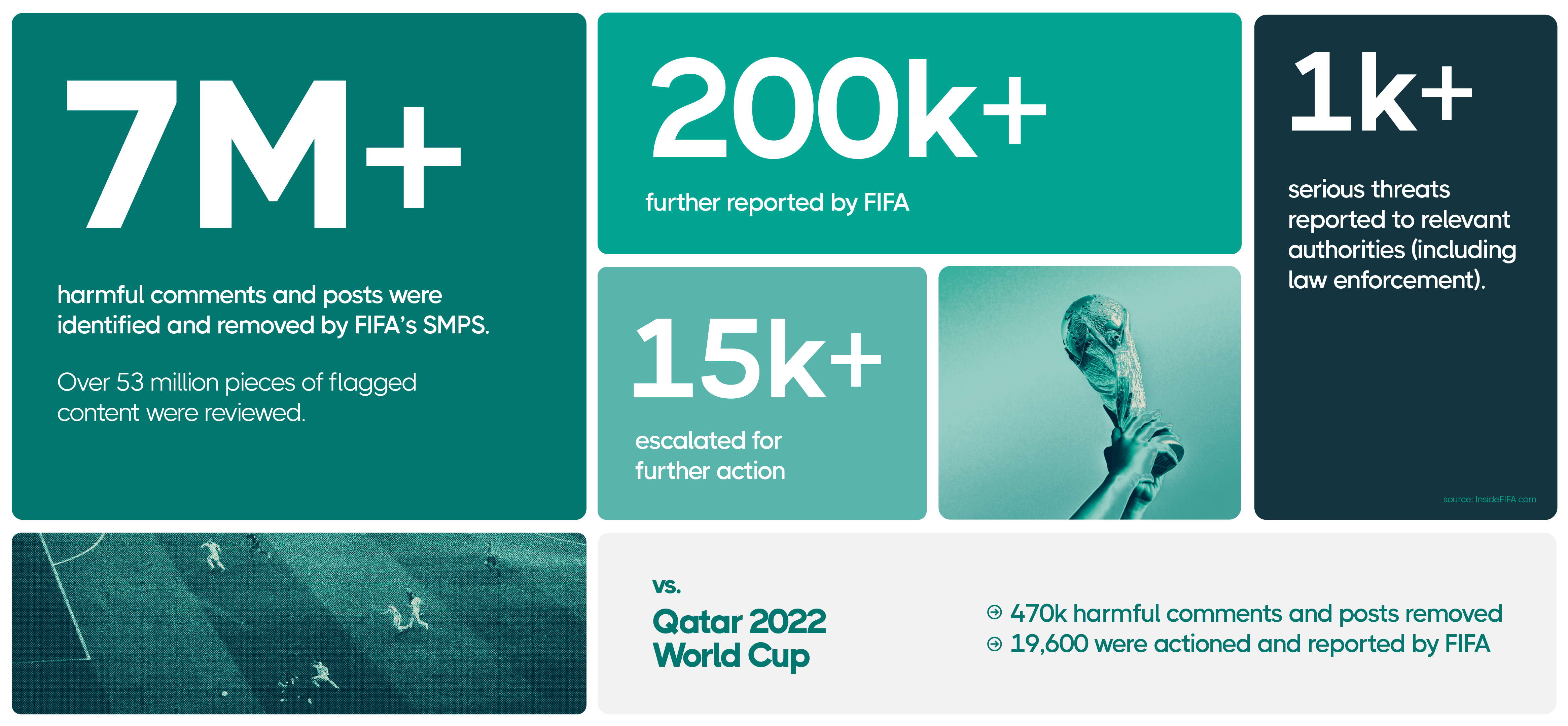
Since the start of the 2026 FIFA World Cup, FIFA's Social Media Protection Service reviewed more than 53 million pieces of content across major social media platforms.
Of those:
- More than 7 million harmful comments and posts were identified and removed. Did you know this is more than the combined stadium attendance numbers for all 104 matches. (6,810,966)
- Over 200,000 items were formally actioned and reported by FIFA.
- More than 15,000 cases were escalated for further investigation.
- More than 1,000 serious threats were referred to the relevant authorities, including law enforcement.
By comparison, during the 2022 FIFA World Cup in Qatar:
- Approximately 470,000 harmful comments and posts were removed.
- Around 19,600 cases required further action by FIFA.
The increase is extraordinary.
It's worth noting that FIFA released these figures on 18 July, one day before the World Cup final. They therefore exclude activity generated during one of the tournament's most-watched matches. As a result, the final tournament totals are expected to be even higher, further highlighting the unprecedented scale of online abuse witnessed throughout the competition.
While advances in monitoring technology have undoubtedly improved detection, the figures also reflect a worrying reality. Harmful online behaviour is becoming more frequent, more visible and increasingly normalised during high-profile global events.
According to a Professional Footballers Association (PFA) survey, almost one in three professional footballers say their mental health has been impacted by online abuse.
Importantly, FIFA's strategy extends beyond simply removing abusive content.
By identifying and filtering harmful posts before players, officials and supporters are exposed to them, the organisation is actively reducing the reach and visibility of online abuse. That not only protects those directly targeted but also helps prevent this behaviour from becoming accepted as a normal part of sport.
At Farosian, these findings reinforce something we've observed for years.
Major sporting tournaments and election seasons consistently coincide with spikes in risky online behaviour.
Heightened emotions, fierce loyalty and the perceived anonymity of social media often encourage people to act differently online than they would offline. In the heat of the moment, many fail to consider the lasting consequences of what they share.
The important thing to remember is that these posts and comments are not coming solely from anonymous internet trolls.
They are shared by real people.
Employees. Managers. Executives. Future job applicants. People who represent organisations every single day, whether they realise it or not.
The reputational risks associated with harmful online behaviour don't disappear when the tournament ends. A single post made in frustration can resurface months or even years later, affecting careers, organisations and reputations.
This is why periods of heightened public attention should also be periods of heightened organisational awareness.
Social media screening enables organisations to identify potential digital risks before they become business risks. When combined with comprehensive digital literacy training and well-defined social media policies, organisations can equip employees with the knowledge to engage responsibly online, even during emotionally charged moments.
Rather than simply reacting to reputational crises after they occur, organisations can build a culture where employees understand the impact their online behaviour may have on themselves, their colleagues and the brands they represent.
The sun has set on another FIFA World Cup, but the conversations it sparked online will continue long after.
Sport, in all its forms, has always been built on passion. Social media has simply amplified that passion, for better and for worse.
The challenge isn't preventing people from expressing opinions online. It's ensuring those opinions don't cross the line into hate speech, abuse or unlawful behaviour.
History has shown us that major global events will continue to trigger spikes in harmful online activity. The real question is whether individuals, organisations and platforms will be better prepared when the next one arrives.

Explore Our Insights
Dive deeper into our latest articles.